Flying over Great Salt Lake, Utah - And What I Learned About Our Water Crisis
The State of the Great Salt Lake Ecosystem
Over a year ago I submitted an application to fly with EcoFlight, a nonprofit organization that uses small aircraft to advocate for threatened lands and watersheds. I hoped that peering down from a small Cessna would grant me a better perspective on just how our inland sea, Great Salt Lake is truly faring.
Let me start off by explaining to those of you who are new to the issues surrounding Great Salt Lake. Our terminal lake is on the verge of collapse, and over the past century she has been horribly mistreated, misused, and mismanaged. Think of GSL (Great Salt Lake) and the three rivers who who pump vital life into her as a vascular system, our lake as the heart, and the three rivers - the Jordan, Weber, and Bear as the arteries. These three rivers are essential for her life, and from my recent explorations, I discovered that those rivers are being depleted by overuse before they even get a chance to reach Great Salt Lake. “Grow the Flow,” a citizen-led non-profit group who is advocating for Great Salt Lake has a lake tracker on their website. Here is the recent data:
The Great Salt Lake is 6.1 feet below the minimum ecological healthy level of 4,196’
Over 53.5% of the lakebed is completely exposed to the wind
The entire basin is currently resting at just 36.1% its total water capacity
In this post, I will explore and share with you:
The conservation mission of EcoFlight
Aerial Images Documenting Industrial Impact
The Unique Technical Challenges of Aerial Photgraphy
A Metaphorical Analysis: Comparing a Dying Body to a Collapsing Lake
Confronting Questions and Action Local Communities Must Take


Three of the many islands on Great Salt Lake.

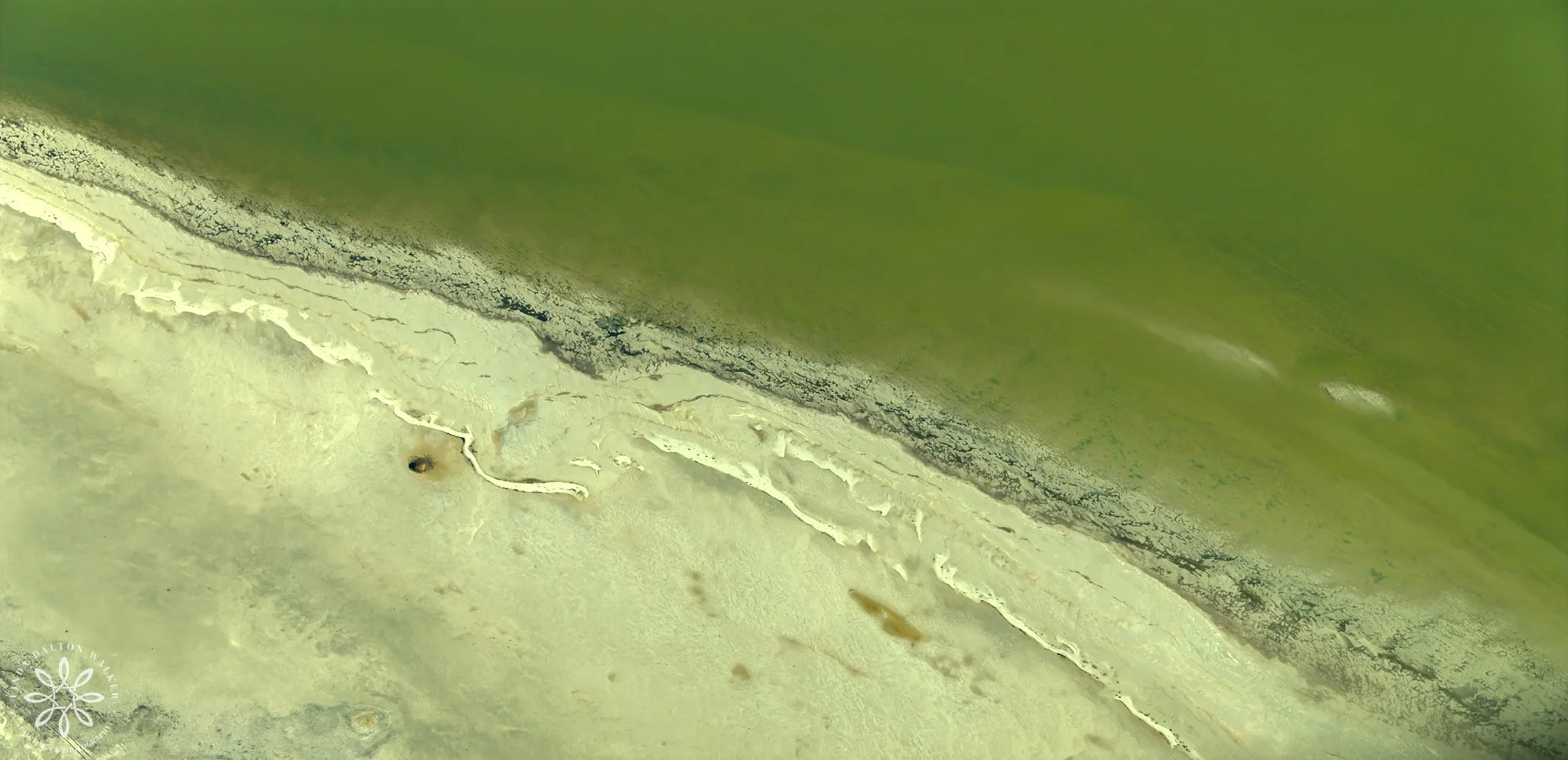
Microorganisms and Algae Growing on Great Salt Lake.
An Aerial Perspective: Worse Than Imagined
Flying above our beloved lake, I felt more ravaged than I thought I would, I was near tears as I peered out the window, and had to pause to catch my breath. Our lake looks sick, and she looks so much worse from the air than when I had observed her from the shore, a reality I didn’t think was possible.

There are Currently 21 Active Mineral Extraction Industries Operating on Great Salt Lake
These commercial industries aggressively extract water, brine shrimp, and brine flies to harvest lucrative minerals, including: Sulfate of Potash, Magnesium Chloride, Salt - Sodium Chloride, and Lithium.
As we flew overhead our fractured lake and the industrial usage was pronounced. For decades, the state has treated this basin as a liquid commercial asset, rather than a living body of water that has sustained this valley for a millennia. As the water table drops, heavy metals like arsenic, mercury, lead and copper settle into the newly exposed soil, threatening to turn our winds into toxic dust storms that poison the air along the Wasatch Front.
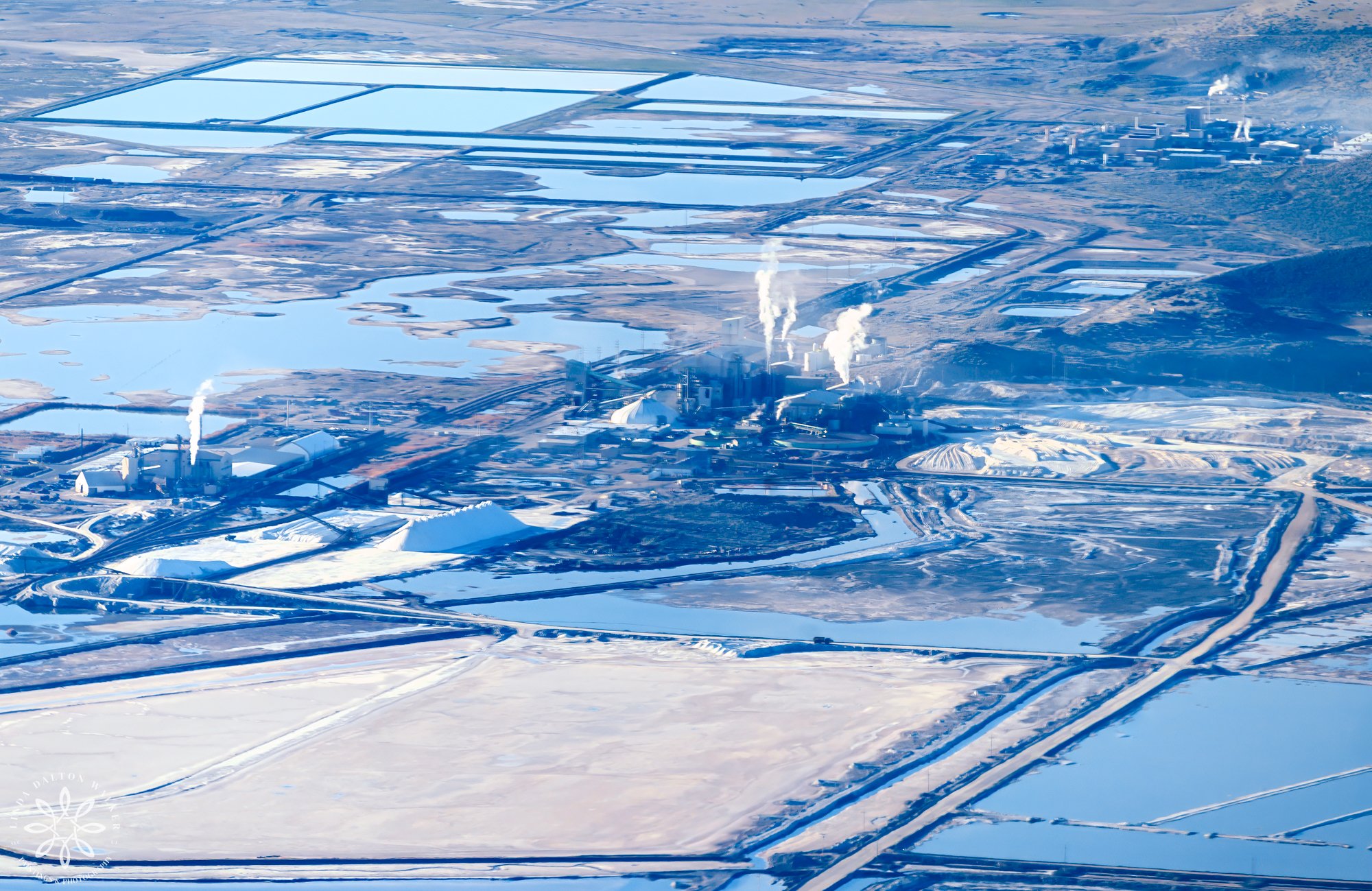
Aerial view of Compass Minerals
The Industrial Footprint of Compass Minerals
The specific corporation captured in my aerial images above is Compass Minerals. While corporations are granted legal rights to extract resources, the Great Salt Lake itself possesses no inherent legal rights to exist or flourish.
Compass Minerals:
Massive Scale: Operates a staggering 55,000-acre solar evaporation pond in Great Salt Lake.
Production Monopoly: They are the largest producer of sulfate of potash and magnesium chloride in North America.
The Consumption Toll: Operating on these shores since 1970 along the boundaries of Bear River Bay, Ogden Bay, and Clyman Bay, this single entity is the largest mineral extraction water consumer on the lake. They deplete 111,700 acre-feet of water annually, primarily open solar evaporation.
Ecosystem Disruption: To flush excess salt crusts from their evaporation ponds the company uses fresh water directly from Bear River Bay, a vital wetland for aquatic and avian species.
Whenever you look at my aerial photographs and see sharp, artificial geometric lines fracturing the water, know that you are witnessing the heavy hand of commercial extraction carving up a dying lake.

EcoFlight’s Logo
EcoFlight Draws Attention to Conservation and Environments
EcoFlight takes people above regions of land, to help draw attention to crucial environmental conservation issues and spark systematic change.
As stated directly in EcoFlight Mission Statement:
“EcoFlight uses a small aircraft to provide the aerial perspective to educate and advocate for our remaining wildlands, watersheds, and culturally important landscapes. From the air, we connect stakeholders with differing viewpoints to advance our goals of conservation and environmental justice.”
Their team was incredible to collaborate with. If you want to support their vital aerial advocacy work, you can read more and donate directly to their efforts on the EcoFlight Donation Page.

When a Lake Nears the End of Life
During the flight, I zoomed my camera lens to photograph a desperately shallow layer of remaining water. Beneath the surface layer, dark, exposed crusts of dying plant life choked the places where deep water should have been. The sight immediately triggered a human parallel. It reminded me vividly of the final stages of human life, when a person’s skin becomes terribly thin, fragile, and papery to the touch. The lake’s protective fluid barrier is evaporating away, leaving her body bare and exposed to the elements. We are finally awakening to this ecological tragedy, but we are doing so almost too late.
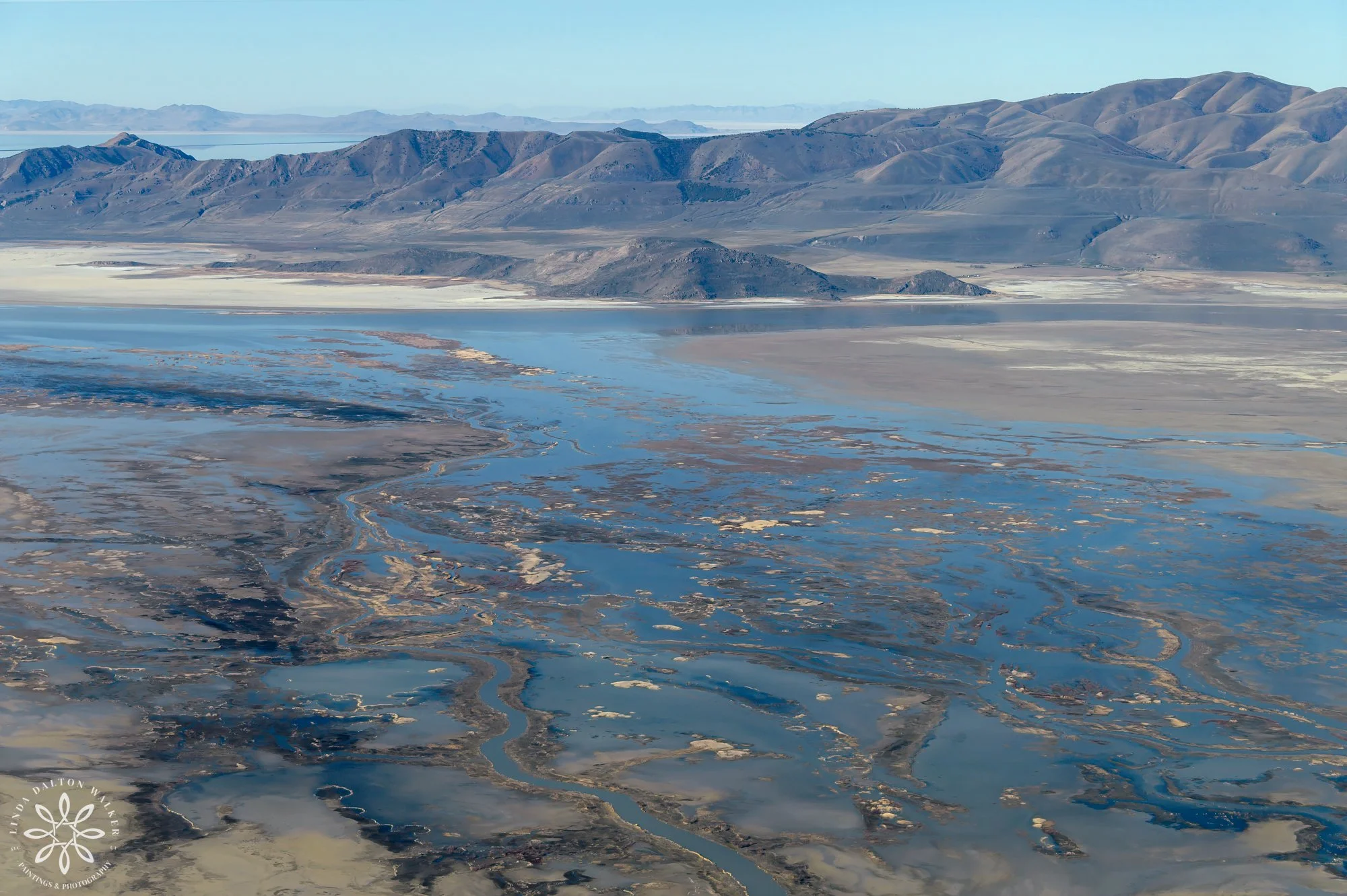
A Haunting Aerial view of Great Salt Lake with Promontory Mountain Range.
I often refer to Great Salt Lake as a mother - Our Mother Lake - she has quietly nurtured generations of us who have grown up along the Wasatch Front. She is a foundational pillar of The State of Utah, constantly giving to our climate, our snowpack, and our birds, always giving, and never asking for anything in return.

Growing Up in the Arms Great Salt Lake
I grew up not only in my own mother’s arms, but in those of Great Salt Lake, floating in her salty waters with my siblings, building sandcastles in the sand with my sons, skiing in the glorious soft powder that only the salt evaporation from our lake can create, and hiking her shores and those of our ancient grandmother, Lake Bonneville. I have spent over the past 30 years, painting and photographing her image and the birds and animals who rely on her for survival. Seeing her body carved up by ownership and industry forces a crucial question: What if Great Salt Lake had legal rights? What if she possessed the inherent right to flow freely, to flourish, and to be protected from total consumption.

The Technical Art of Aerial Conservation Photography
Capturing these frames from a moving aircraft required drawing on every single ounce of my 30+ years of professional camera experience.
Photographing through a thick plexiglass window of a Cessna renders an unwanted greenish cast to raw images. Because this green sits directly across from red and pink on the color wheel, this tint completely neutralizes the beautiful subtle rose and magenta hues naturally found in the northern section of Great Salt Lake.
Having previously photographed from helicopters and float planes across the rugged terrain of Alaska, I knew the steep challenges ahead. We were moving roughly 120 miles per hour, battling engine vibrations, and shooting through a scratched, tinted window. Despite the physical and technical limitations of working inside a tight cockpit, the ultimate reward is creating high-impact visual art that forces the public to confront an environmental crisis they cannot see from the ground.
Furthermore, shooting through older plexiglass creates a distinct lack of sharp focus due to minor surface abrasions and aircraft vibration. To say I spent long, grueling hours in post-processing correcting these images in an absolute understatement.
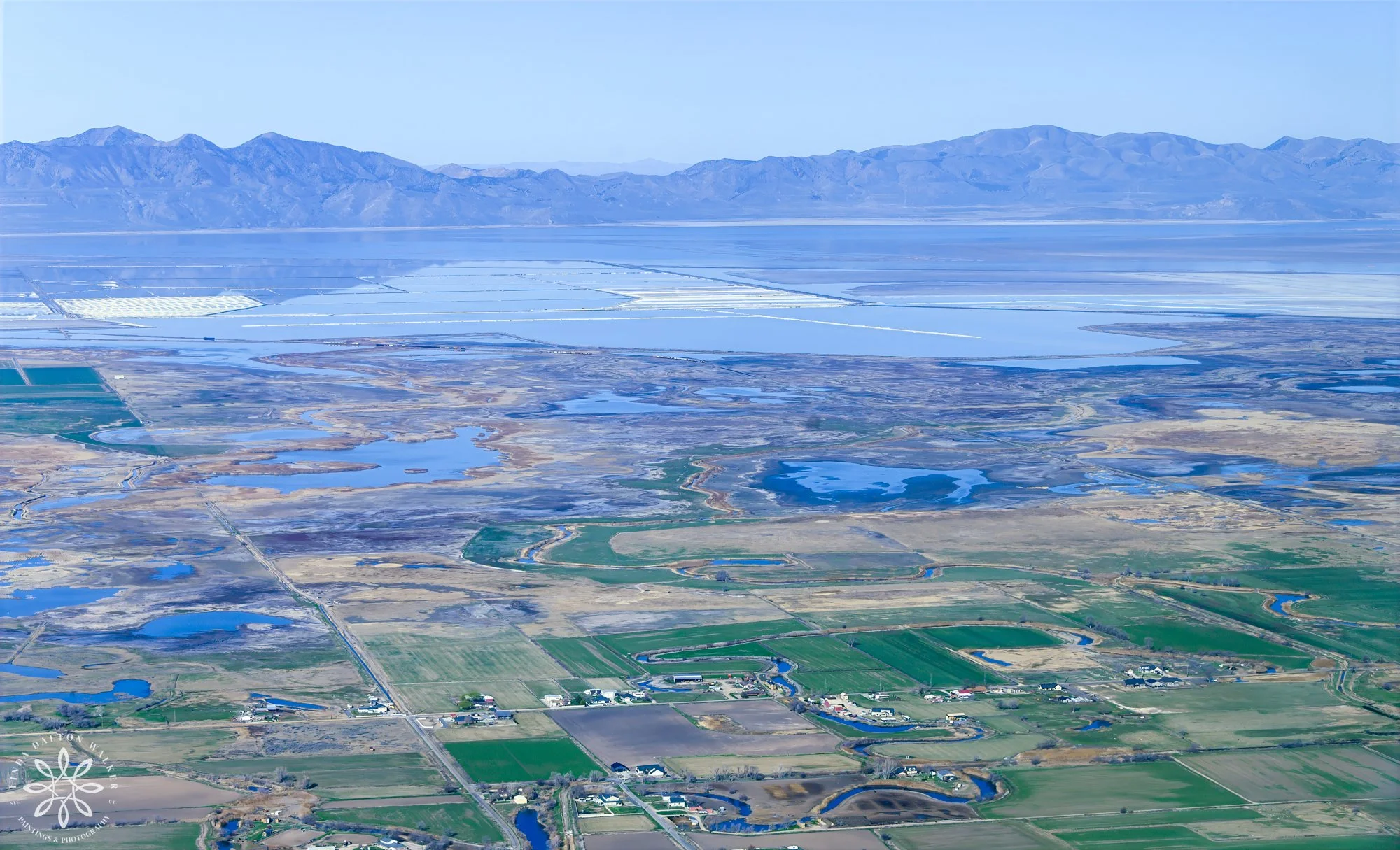
Approaching Great Salt Lake
Despite these exhausting technical limitations, if this is the only way I can secure visual evidence to show our community just how critical this period of time is for our ecosystem, I will gladly keep flying. I am ultimately very proud of these resulting images. If you would lie to help support my conservation photography and add these unique perspectives to your personal art collection, please reach out to me directly through my website Contact page.
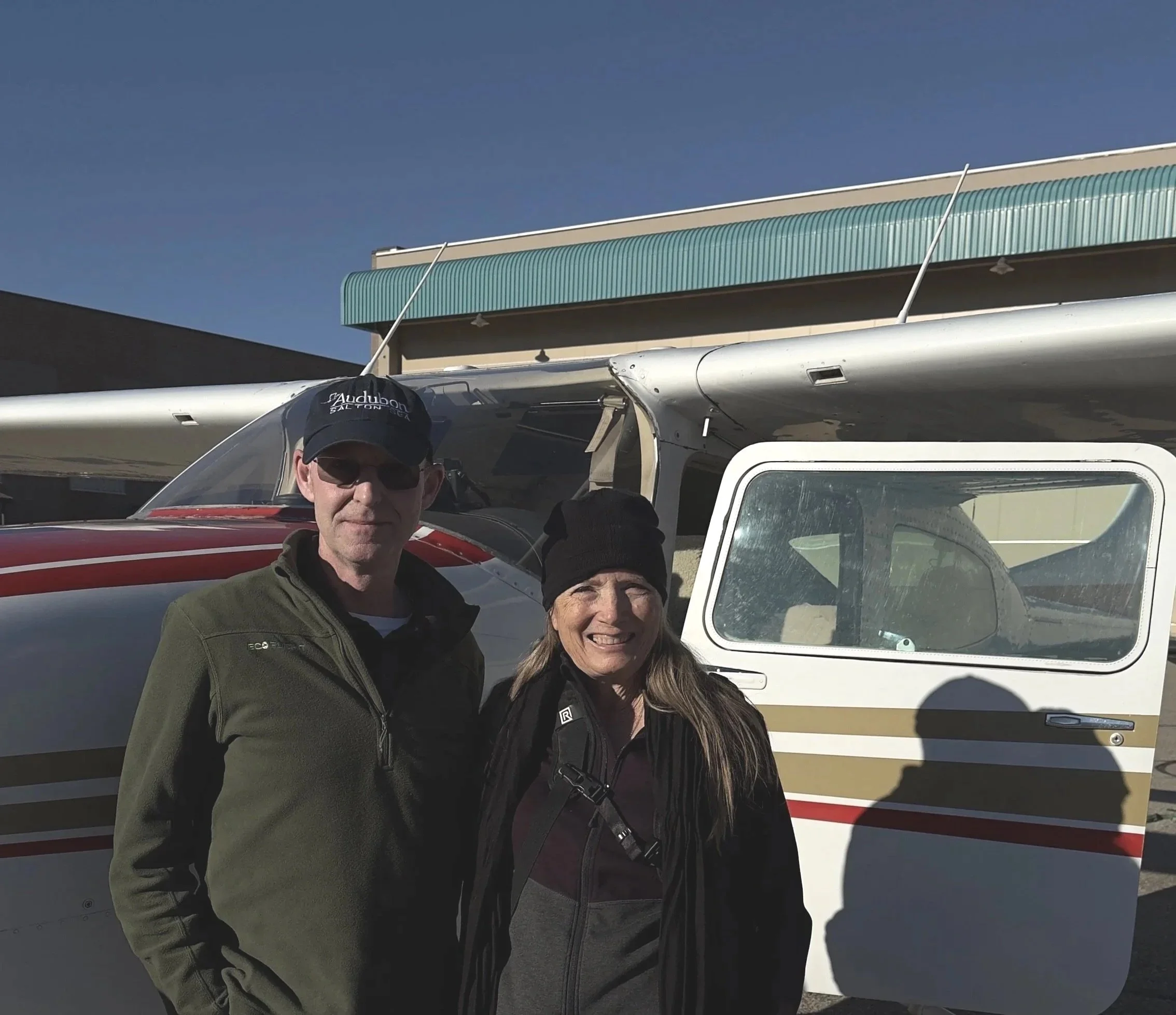
Eco Flight Pilot, Gary
Our pilot, Gary, put me in the seat behind him, so if at any moment I wanted him to open a window for me to photograph, I could just let him know. Being ready for an open window took a bit more preparation and thought. I instantly took off my lens hood, so I wouldn’t lose it into the landscape below. We only tried the open window three times because it created quite a bit of turbulence inside the small aircraft. The rest of them are taken through the window.

Opening the Window to a Dying World
When our flight path carried us directly over the North Chamber of the Great Salt Lake, my eyes could see vibrant pinks and deep reds, but my camera viewfinder was completely neutralizing them through the green-tinted window. I asked our pilot, Gary, if he could open the window next to him. I was entirely unprepared for the violent blast of wind that rushed into the plane. Keeping my camera steady at 120 miles per hour became an immense physical challenge. To make matters worse, right before opening the window, I had draped my black scarf over Gary’s white seat covering because its bright material was casting a harsh reflection onto the glass. As the wind tore through the cabin, I almost watched my scarf fly into the sky. Luckily, I retrieved it just in time.
I photographed this image when we quickly opened the window. I keep my camera locked into a harness system that drapes over my shoulders. This is crucial just in case I accidently drop it while walking, in an airboat, or flying in a Cessna with the window open. It’s a security I have come to understand as important.

Photographed with the window open.
In this way I was able to capture the true colors below me.
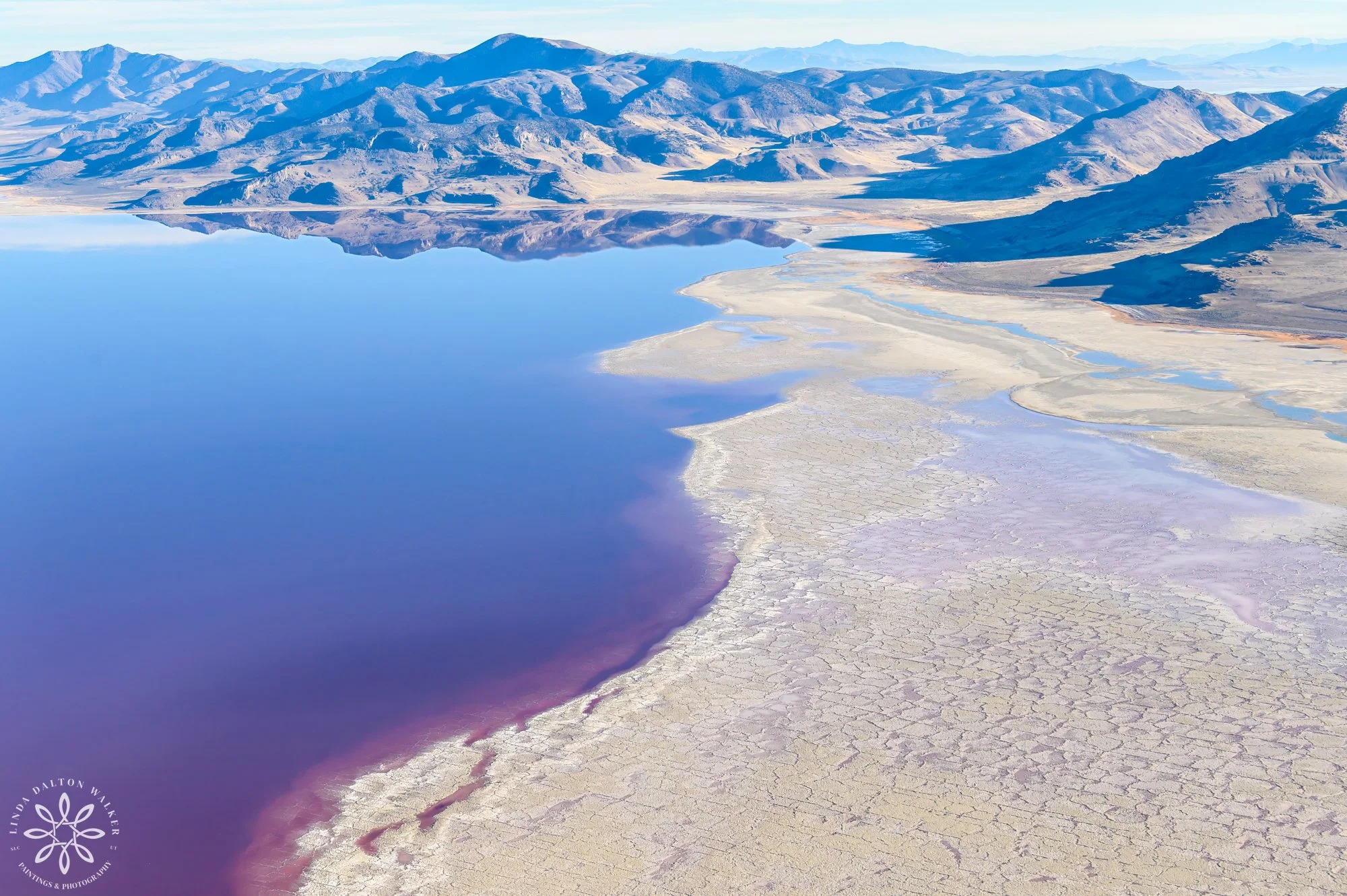
A Divided Heart: Why the North Chamber is Pink
The stark images I captured reveal the physical devastation of the Lucin Cutoff, a prominent railroad trestle that sliced the Great Salt Lake nearly in half. Many of our local governing officials want this northern region of our lake to be completely cutoff.
Because GSL is a terminal lake, there is no natural outflow. With the railroad cutoff acting as a solid barrier, there is no flow into the Northern Chamber from the Southern Chamber of GSL. If we imagine our lake as a living organism, it becomes painfully obvious how this would feel to her. The death of one chamber of the heart is the beginning of the death for the entire body. Everything in a watershed is connected.
The surreal, brilliant pink hue in the North Chamber of Great Salt Lake is an example of extreme, unnatural salinity levels. Because this chamber is cut off from fresh inflows, its water has evaporated down to more than double the salt concentration of the southern basin.
The high salinity in the north chamber creates a perfect environment for the salt loving microorganisms:
Halobacteria: microscopic organisms that thrive in extreme salt conditions.
Dunaliella Saline Algae: A unique algae species that produces massive amounts of red and pink carotenoid pigments to protect itself from intense solar radiation.
These organisims can only survive in waters that are 30% or higher in salinity. For context, our global oceans maintain an average salinity of 3.5%. The beautiful pink water is not a sign of health, it is the visual signature of a lake drowning in its own brine.

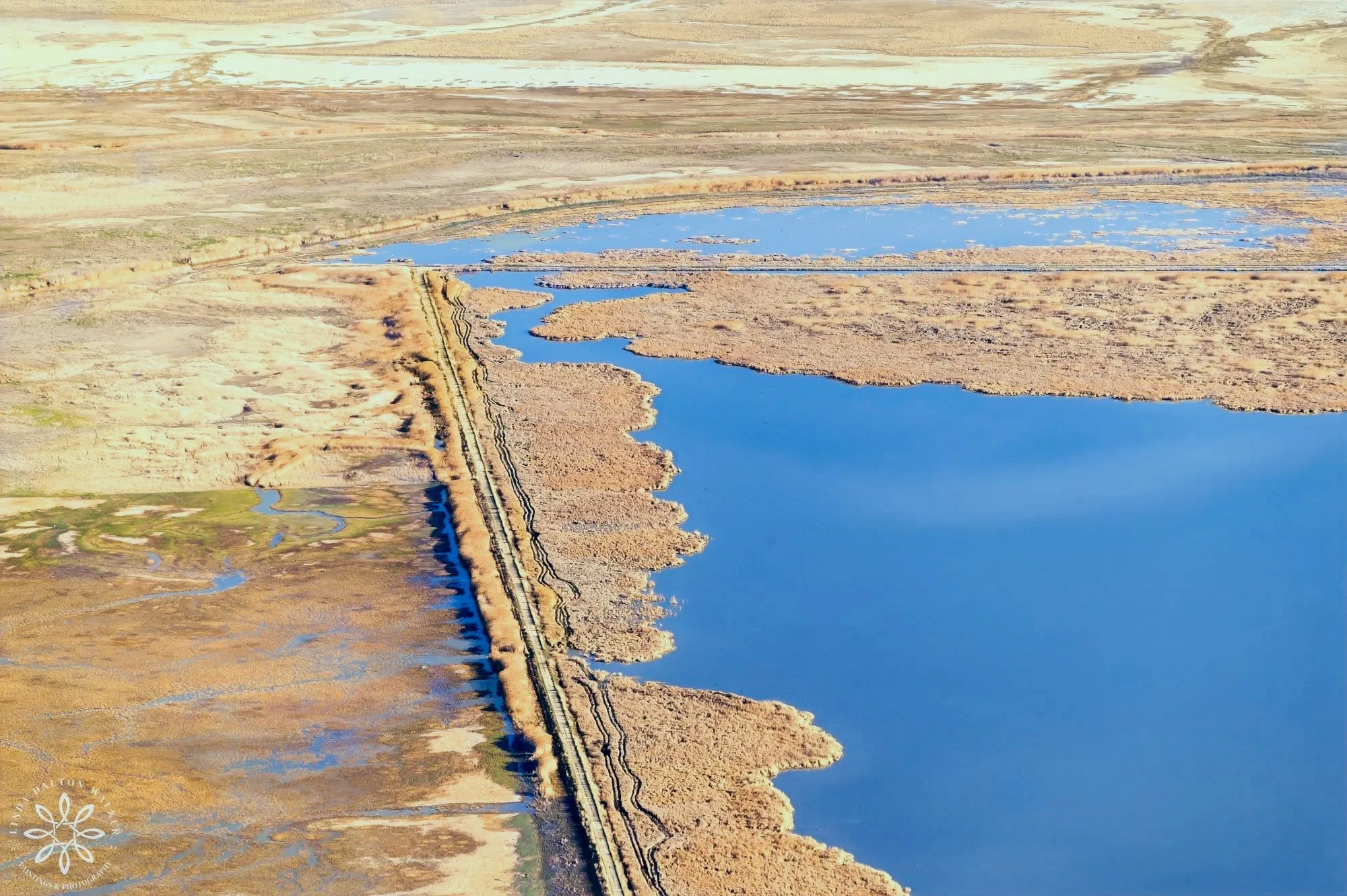
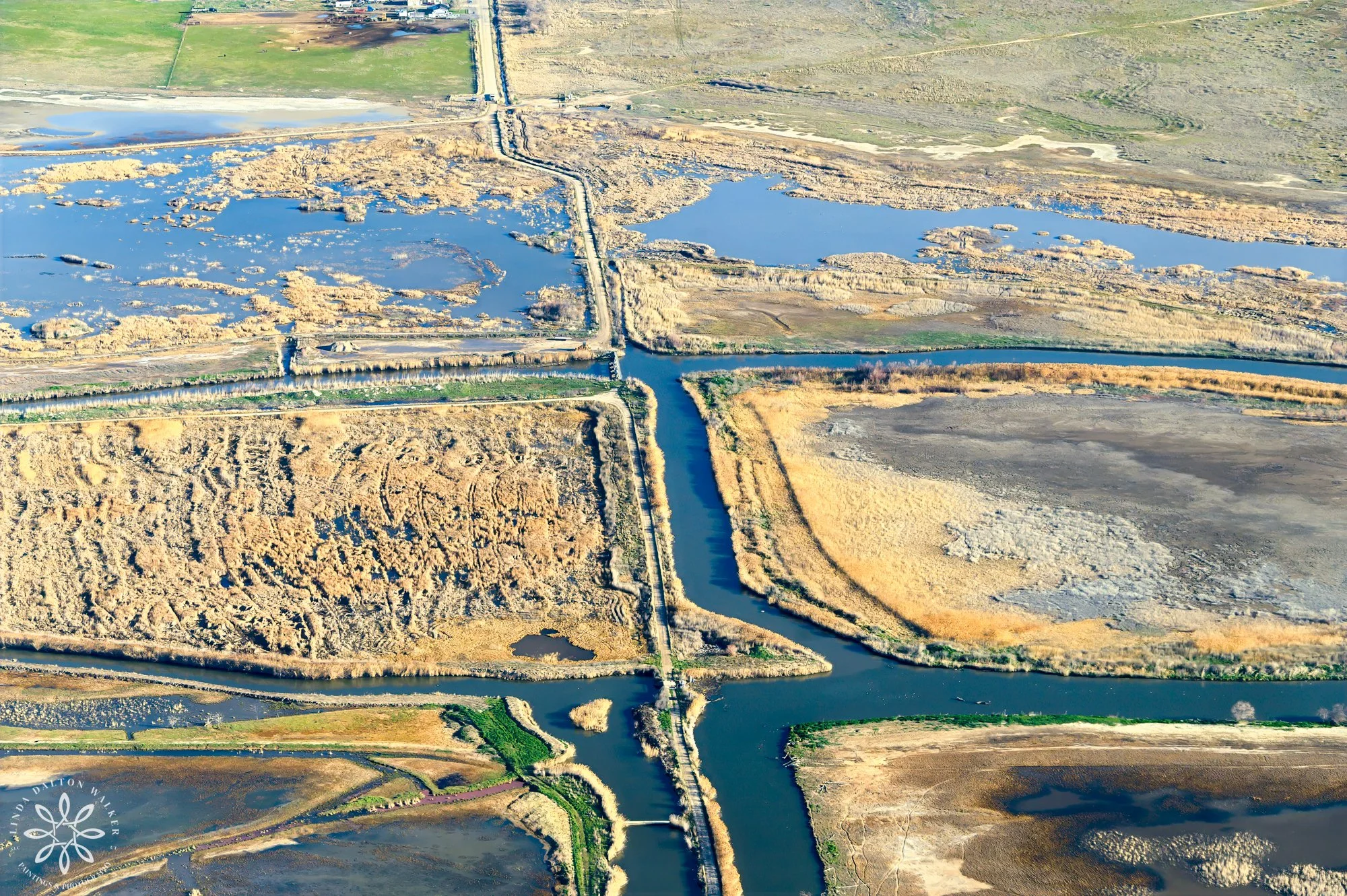
Traces of Management: What Is A Mulch Masher?
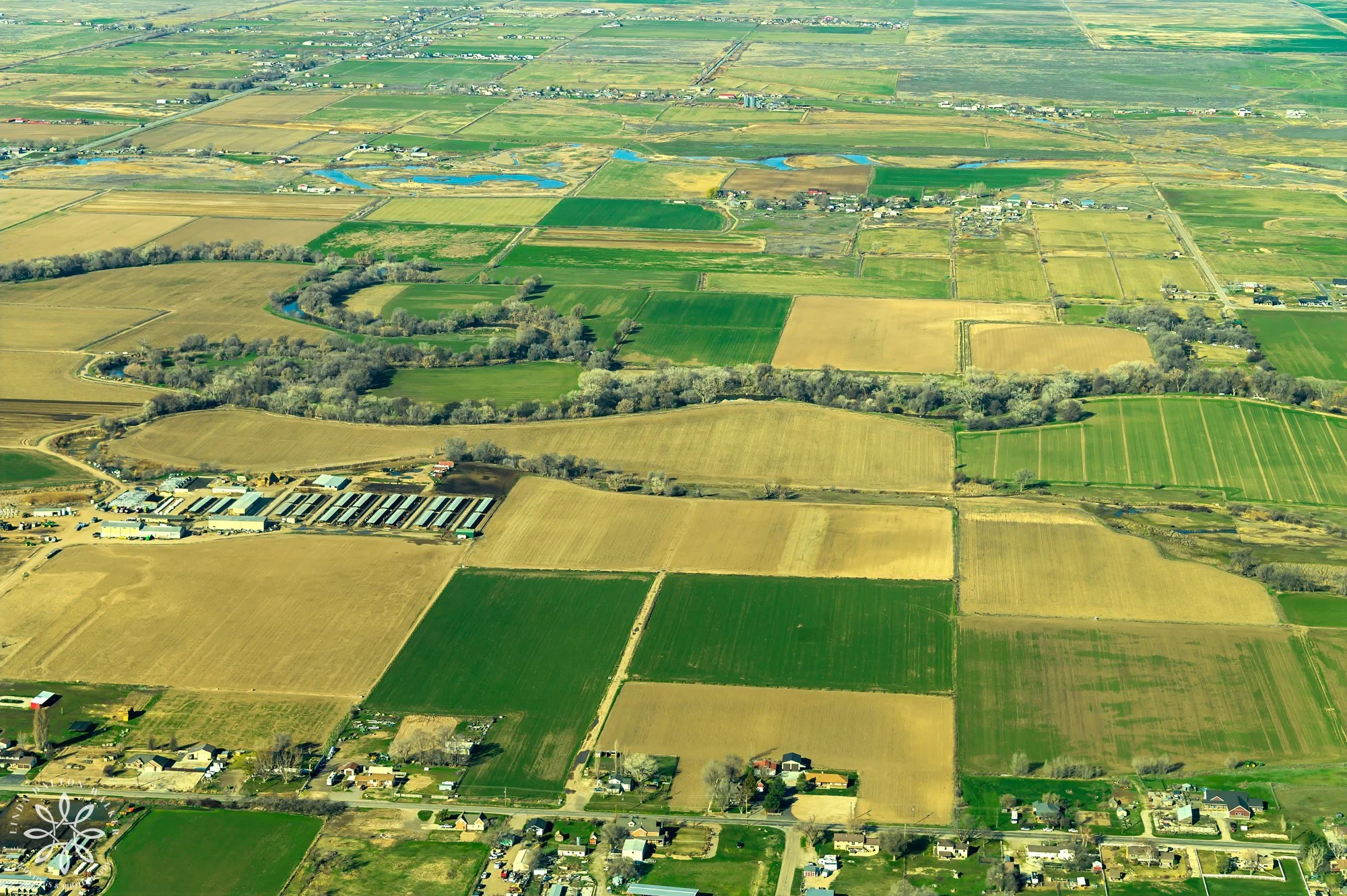
As we flew over the fragile wetland, odd, geometric cutting lines carved into the landscape caught my eye. These are tracks left by a Mulch Masher, a heavy, specialized industrial mowing amphibious machine designed to grind through shallow mire and cut down invasive plant species. The machine’s primary target on Great Salt Lake is Phragmites, an aggressive, non-endemic reed that has completely overrun our native wetlands.
This plant is a massive drain on our water crisis:
Water Depletion: Phragmites aggressively consume double the amount of water required by native Utah salt grass.
Habitat Destruction: By choking out open water channels and eliminating native grasses, they completely destroy the critical nesting and foraging grounds needed by millions of migratory birds.
While local wetland management are taking immense action to clear these invasive plants, these labor-intensive mechanical removal operations are desperately underfunded and understaffed.
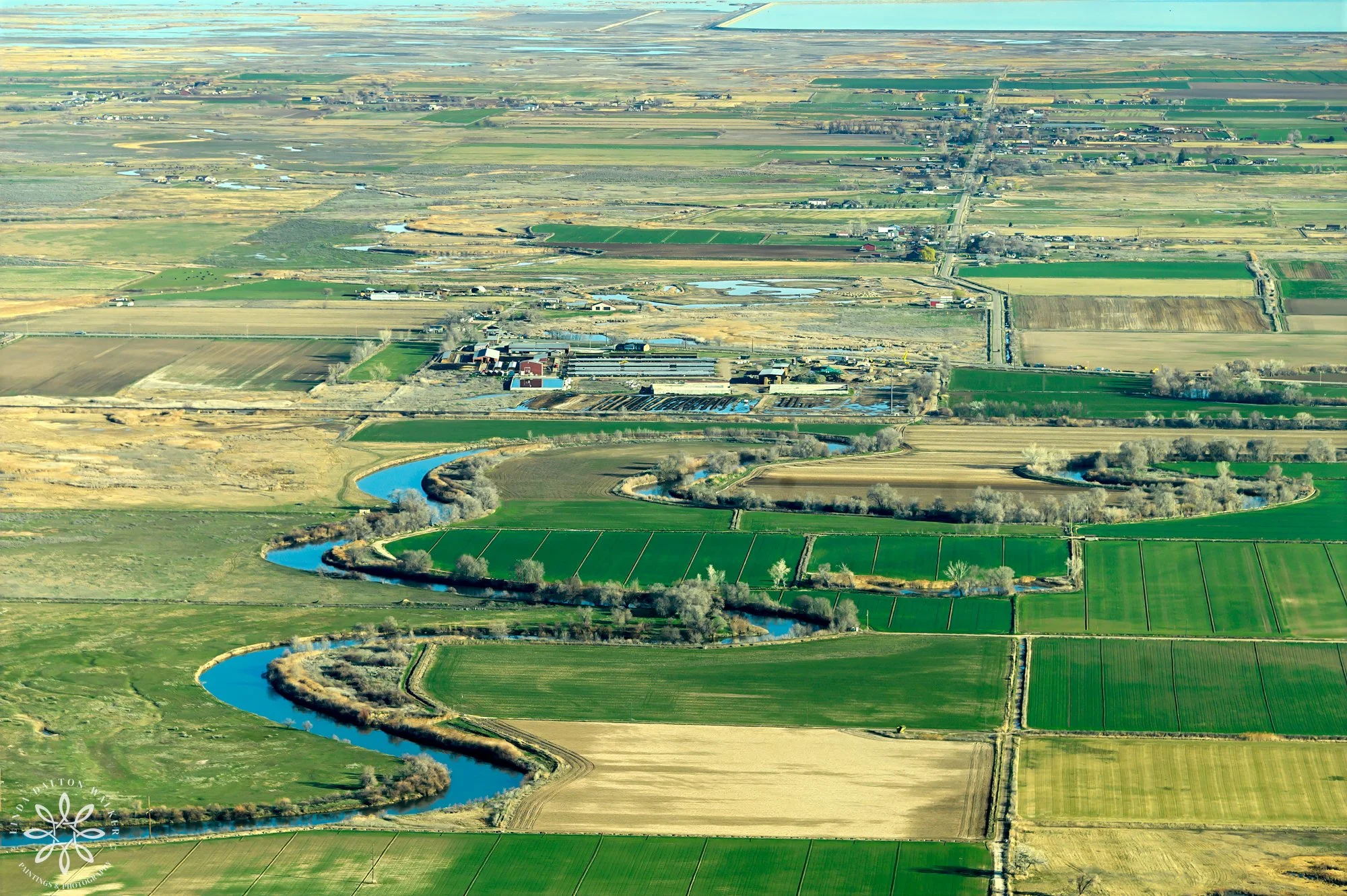
Reimagining an Ending: The Final Correlation
Peering down from the Cessna, the haunting correlation between a human body dying and an ancient lake collapsing felt entirely indistinguishable.
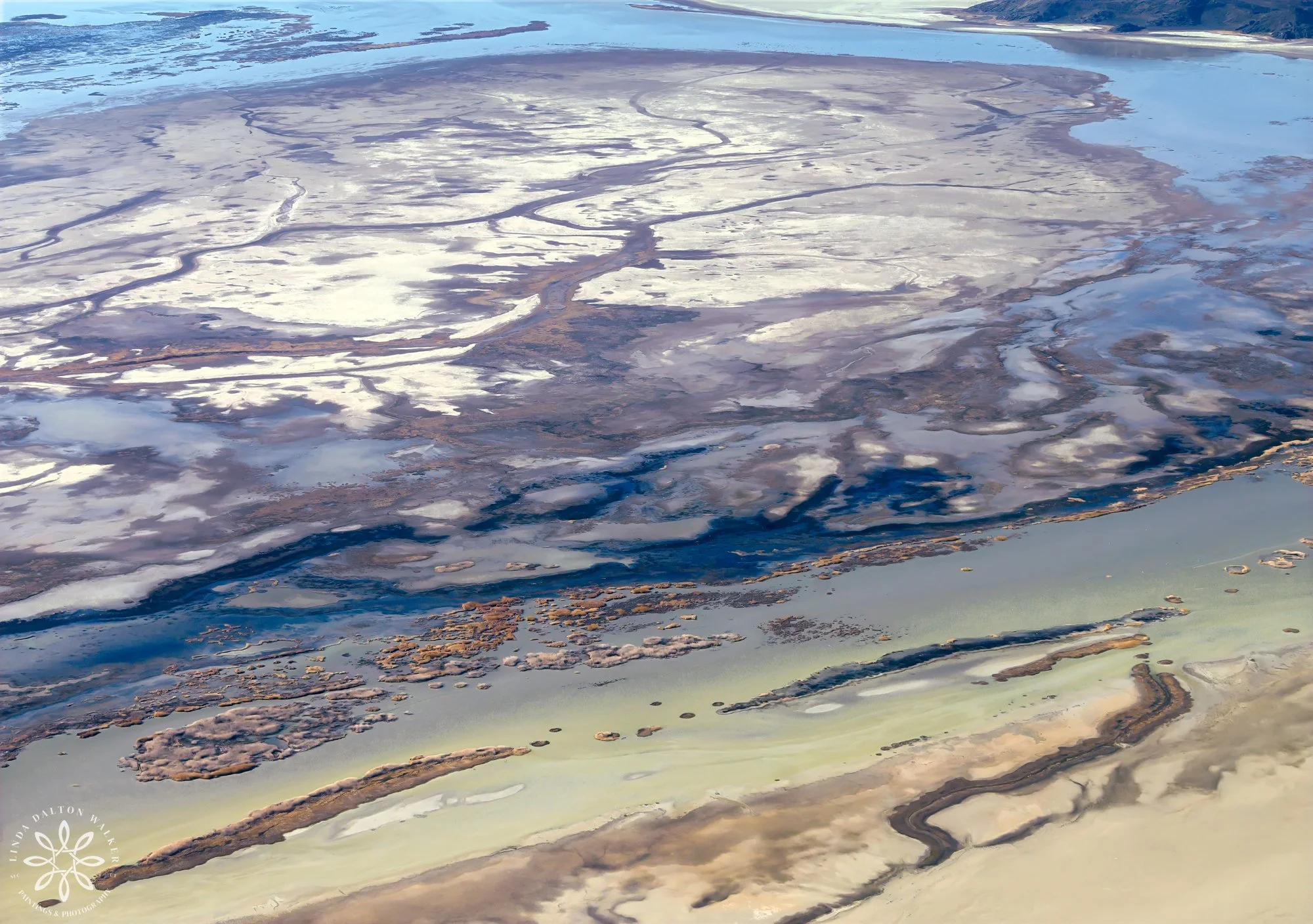
When a living being enters the final stages of life, the heart slows, vital circulation gets cut off, stagnation sets in, and profound systemic, weakening occurs. When a lake is dying, a lack of freshwater circulation turns her waters a stagnate green or brown, mimicking the bluish-gray pallor of a human body losing its oxygenated blood flow. Organic material and heavy sediments pile up in the shallow basins, unable to be broken down quickly enough, until the grand ecosystem is compressed into a shallow evaporating bog.
As I looked across the exposed flats, I realized I was no longer looking at a historic inland sea. I was looking at grand decomposition.

Looking south from Promontory Point onto Great Salt Lake
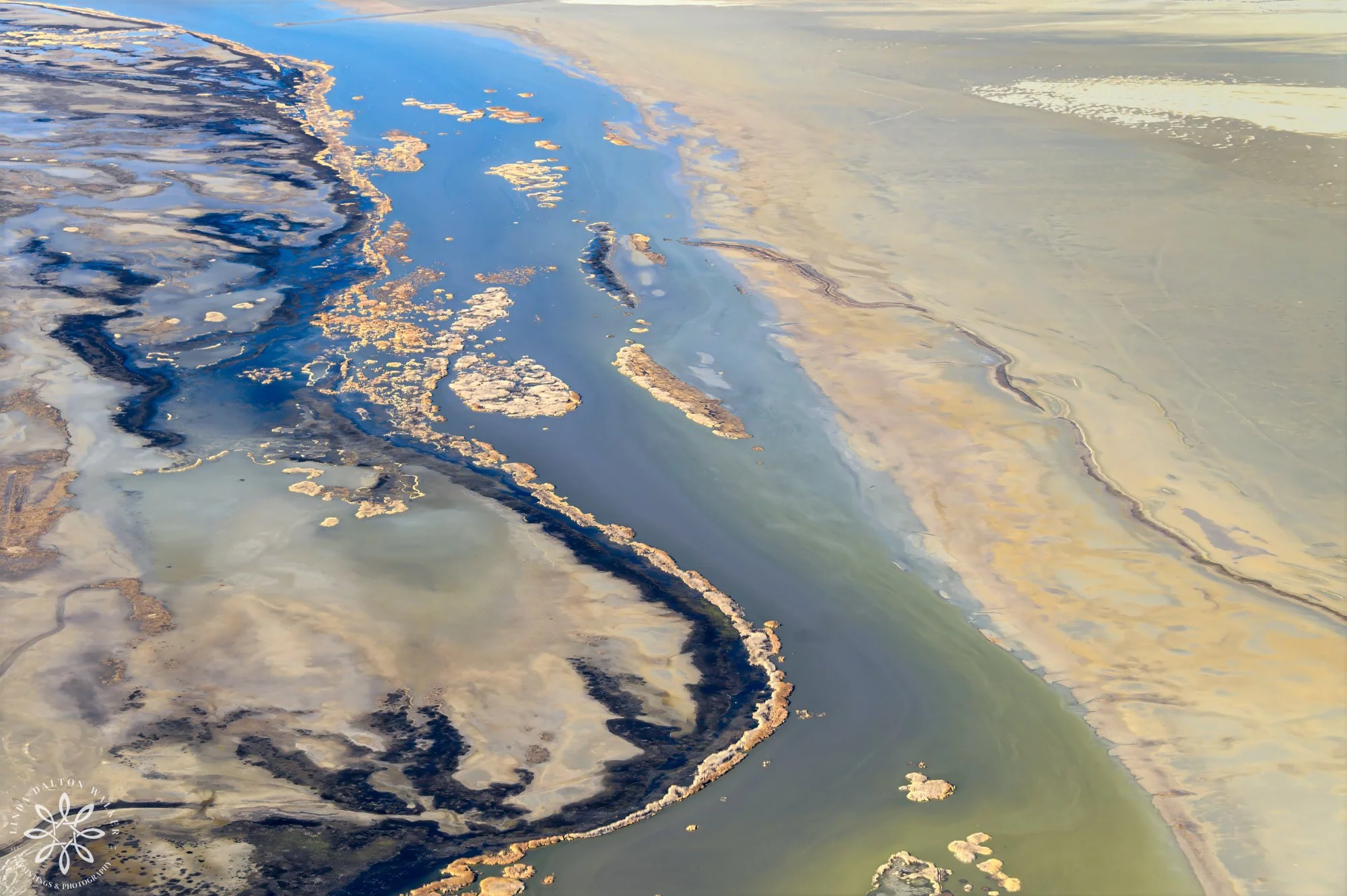
Textures in Great Salt Lake - Aerial views.

Taking Real Community Action To Save Great Salt Lake
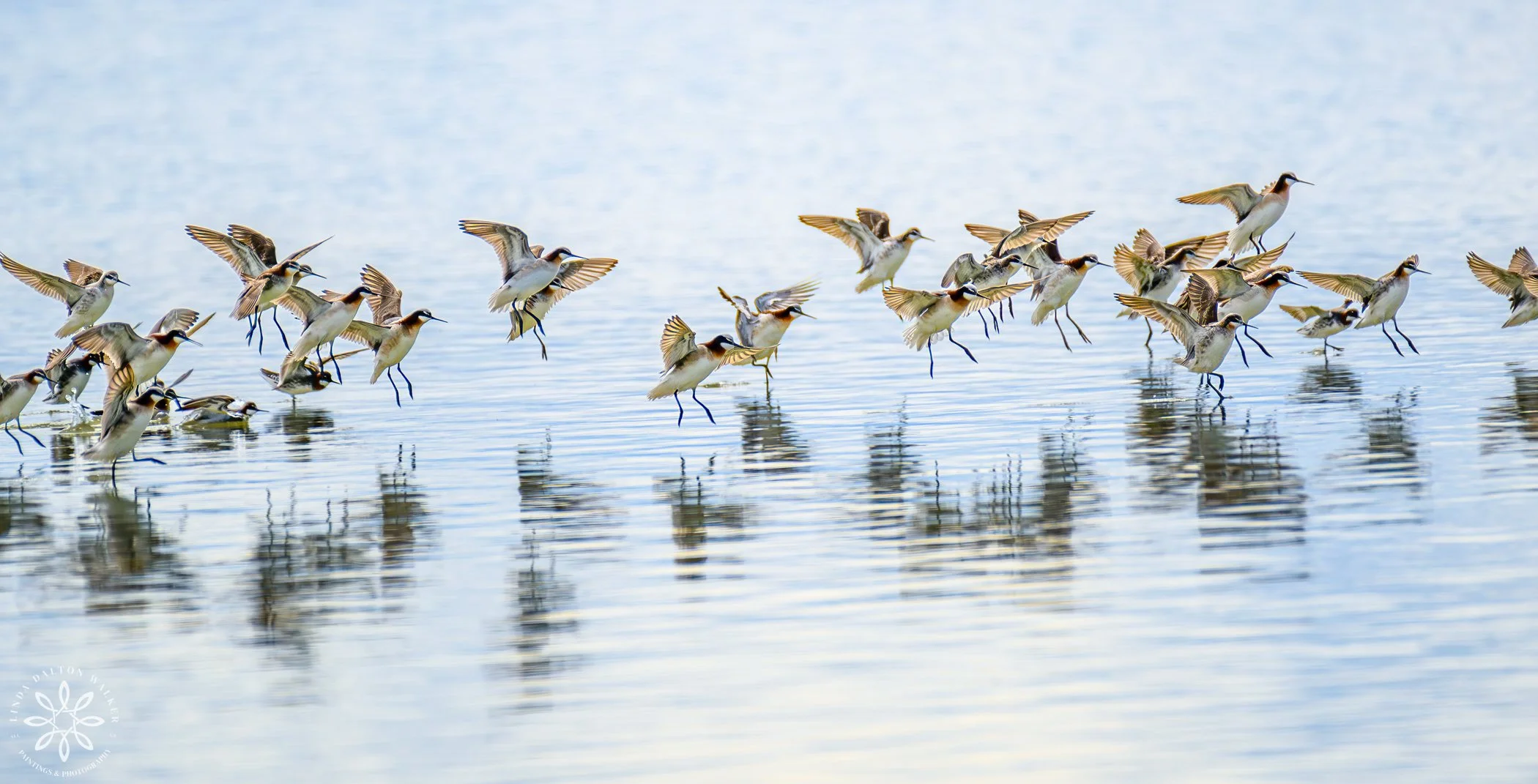
Our lake is actively listening to our choices. We are being watched closely by millions of nesting shorebirds. As they circle the receding shorelines, they are left wondering: Are we still going to have a home?
When a loved one is diagnosed with a terminal illness, family and friends swarm into the room, showering them with medical attention and love that was desperately needed long ago. Everyone wonders if they could have stepped in sooner, and if an earlier intervention would have guaranteed survival.
We are treating the Great Salt Lake with the exact same belated panic, but we are providing the wrong kind of care. Endless scientific research papers and political debates only go so far. A dying body doesn't need another study, it needs emergency action.
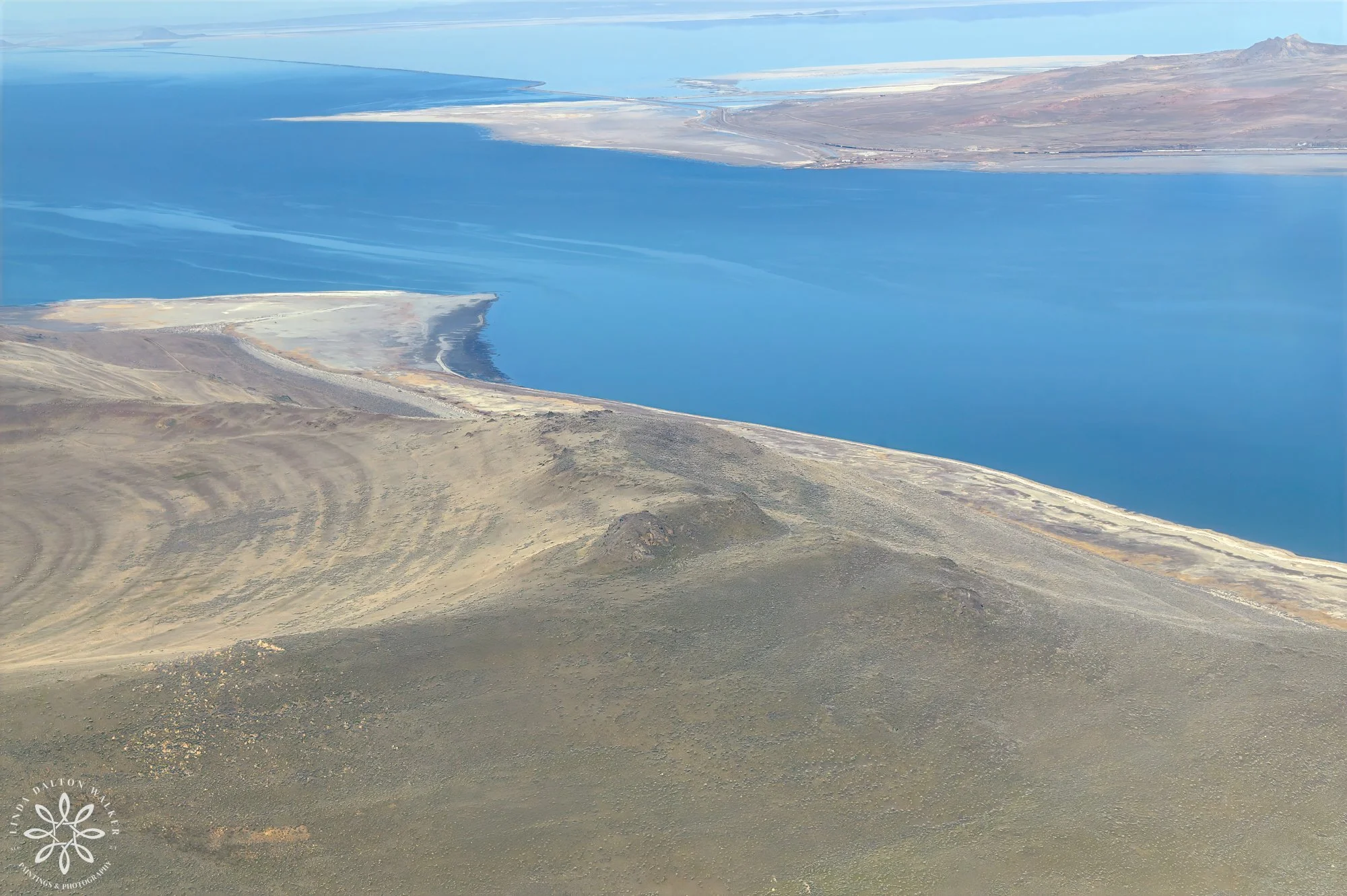
Aerial view of Fremont Island looking northward.
Loss of life, loss of a vital ecosystem destroyed through misuse, mistreatment, and mismanagement.

A view of a dying Great Salt Lake
Let’s write a collective declaration of hope, love, and survival. If the Great Salt Lake could speak, if she possessed the same inherent legal rights to flourish that we freely grant to human citizens and commercial corporations, where would we choose to start?

View over Fremont Island
How You Can Change the Footprint
To ensure the survival of the Great Salt Lake, we must radically alter how we live in the West. As residents of Utah, we can no longer sit back and continue to consume water and use water as if we do not live in the third-driest state in the country.
Conserving water is a lot like backpacking for a long wilderness trek. If I foolishly overload my pack with unnecessary weight, I will deeply regret it just a mile or two down the trail. At this point, I cannot blame the rugged terrain or the steep trail for my exhaustion; I can only blame myself for failing to cut back on what I chose to carry.
Our current water consumption is like an overloaded pack. If we refuse to lighten our load right now, we will collectively face a devastating, toxic dust bowl and the absolute extinction of millions of migratory bird species.
But if we commit to cutting back our residential water usage, eliminate wasteful lawn watering, and hold regional industries accountable, we can preserve our public health and save this irreplaceable ecosystem. We are all bodies of water. As individual, our choices create a ripple effect, and as a unified community we possess the power to rewrite the ending for our Mother Lake.
Behind the Lens: Camera Settings for Aerial Photography
To capture sharp details while soaring above the watershed, I relied on my trusted gear setup. My primary camera selection is always a Nikon, and for this demanding flight, I equipped myself with my Nikon D780 a full-frame body, with the versatile 28 - 300mm Nikkor zoom lens. This specific glass allowed me to quickly transition from vast, sweeping landscape perspectives to tight, abstract close-ups at a single moment’s notice
Because our Cessna was moving at a rapid clip of roughly 120 miles per hour while enduring constant engine vibrations, shooting at ultra-high shutter speeds was an absolute necessity to prevent motion blur.
The vast majority of my 130+ aerial frames were captured using these exposure baselines:
Shutter Speed: 1/2000 to 1/2500 of a second to freeze rapid motion.
Aperture: f/6.3, balancing a sharp sweet spot with maximum light intake.
ISO: Kept at the absolute lowest baseline possible to minimize digital noise.
All of my images in this blog are available, please contact me if you are interested in purchasing any of them.
Bring the Great Salt Lake Into Your Collection
Every single archival photograph featured throughout this blog is available for purchase. Investing in these frames allows you to bring a piece of this raw environmental story into your home of office space while directly funding ongoing conservation photography advocacy.
Thank you for reading, sharing, and supporting my creative mission to preserve the Great Salt Lake and the millions of birds that depend on her waters to survive.
If you are interested in acquiring an archival fine art print from this flight, or if you would like to discuss custom formatting options for your space, please reach out to me directly through my website CONTACT Page. Together, we can make our voices heard. In addition, I have images of Great Salt Lake and her birds photographed from the land or an airboat. Here is the LINK on my webpage.
Upcoming exhibit displaying images from Great Salt Lake and Her Birds.
Red Butte Garden, SLC.
September, 2026.
Reception September 12th with a presentation beforehand.
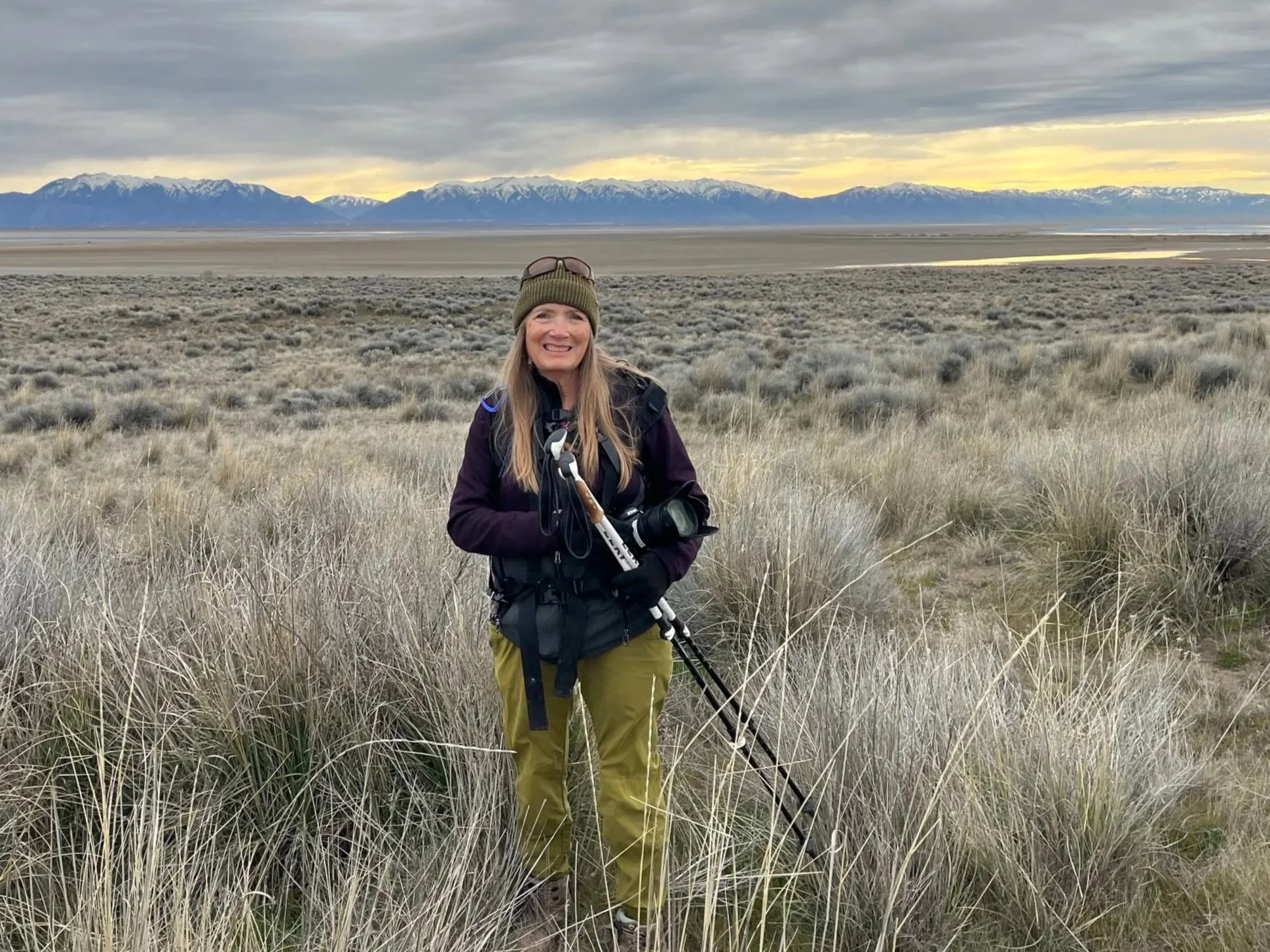
Thank you for supporting my conservation efforts. Let’s do what we can to help save our Great Salt Lake. Linda Dalton Walker
Image credit: Sue Halligan
“Ripples of change comes from throwing the first pebble.” - Linda Dalton Walker
Other Great Salt Lake Images can be found HERE.